What happened
The Packaging and Packaging Waste Regulation (Regulation (EU) 2025/40, PPWR) entered into force on 11 February 2025 and has applied since 12 August 2026, replacing the 1994 packaging directive. According to the European Commission, its aim is that all packaging on the EU market is recyclable in an economically viable way by 2030. Several obligations started in August, among them the rules on substances of concern, limits on PFAS in food-contact packaging, and the manufacturer’s duty to draw up technical documentation and an EU declaration of conformity. Others follow later: harmonised labels on material and sorting from August 2028 at the earliest, once the Commission has adopted the implementing acts, and detailed design-for-recycling criteria from 2030. The Commission published guidelines in March 2026 and frequently asked questions on 3 August 2026. A Commission proposal of December 2025 to simplify some PPWR obligations is still being examined by Parliament and Council; it is a proposal, not law.
The EU Deforestation Regulation (Regulation (EU) 2023/1115, EUDR) covers paper and board. After two postponements, the second by Regulation (EU) 2025/2650 in December 2025, it applies from 30 December 2026 for large and medium-sized operators and from 30 June 2027 for micro and small enterprises. The same amendment took printed products such as books, newspapers and advertising material (HS chapter 49) out of scope. According to Intergraf, the European federation for print and digital communication, printed packaging, labels and stationery remain covered, and so does the paper itself. The Commission published its simplification review on 4 May 2026; the application dates above are unchanged.
What it shows for a printer
For a printer or packaging maker, these rules do not arrive as one new form. They arrive as more documents per order. A quote request comes with specifications on material, dimensions, coatings and finishing. Customers ask for declarations on substances, food contact, recyclability and the origin of paper and board; suppliers of board, inks and adhesives send their own declarations and certificates. After that come the artwork, the proof and the colour check against an approved reference. These are typical patterns in the sector, not findings from the sources above.
- Specifications in every format. Requests arrive as email, PDF or spreadsheet, each describing the same job in its own way.
- Declarations that must match. What a customer asks for has to agree with what the board, ink and adhesive suppliers declare, for that specific order.
- Proofs and colour. A proof is compared with the approved reference, often by eye and from memory of the last run.
A possible approach, step by step
Meridian is not a print MIS or a prepress system and replaces neither. What it can add is the reading and matching around them. This is a possible approach, not a customer case, and each step has its own status. Meridian does not make packaging compliant with the PPWR or the EUDR; responsibility for declarations stays with the manufacturer and the operator. This article is not legal advice.
- 01
Read and stage specifications and supplier documents
Meridian AI reads quote requests, specifications and supplier declarations, extracts the key fields and links each value to where it was found. Missing or conflicting data is marked before anything goes into your systems. Document analysis is an existing capability; connecting your MIS, mailbox and document folders is a project integration.
- 02
Prepare a draft quote with your own costing rules
From the staged specifications, a draft quote is prepared with your costing rules, materials and terms. An estimator checks, corrects and sends it. This is a proposed pilot, not a ready-made product.
- 03
Compare a proof with the approved reference
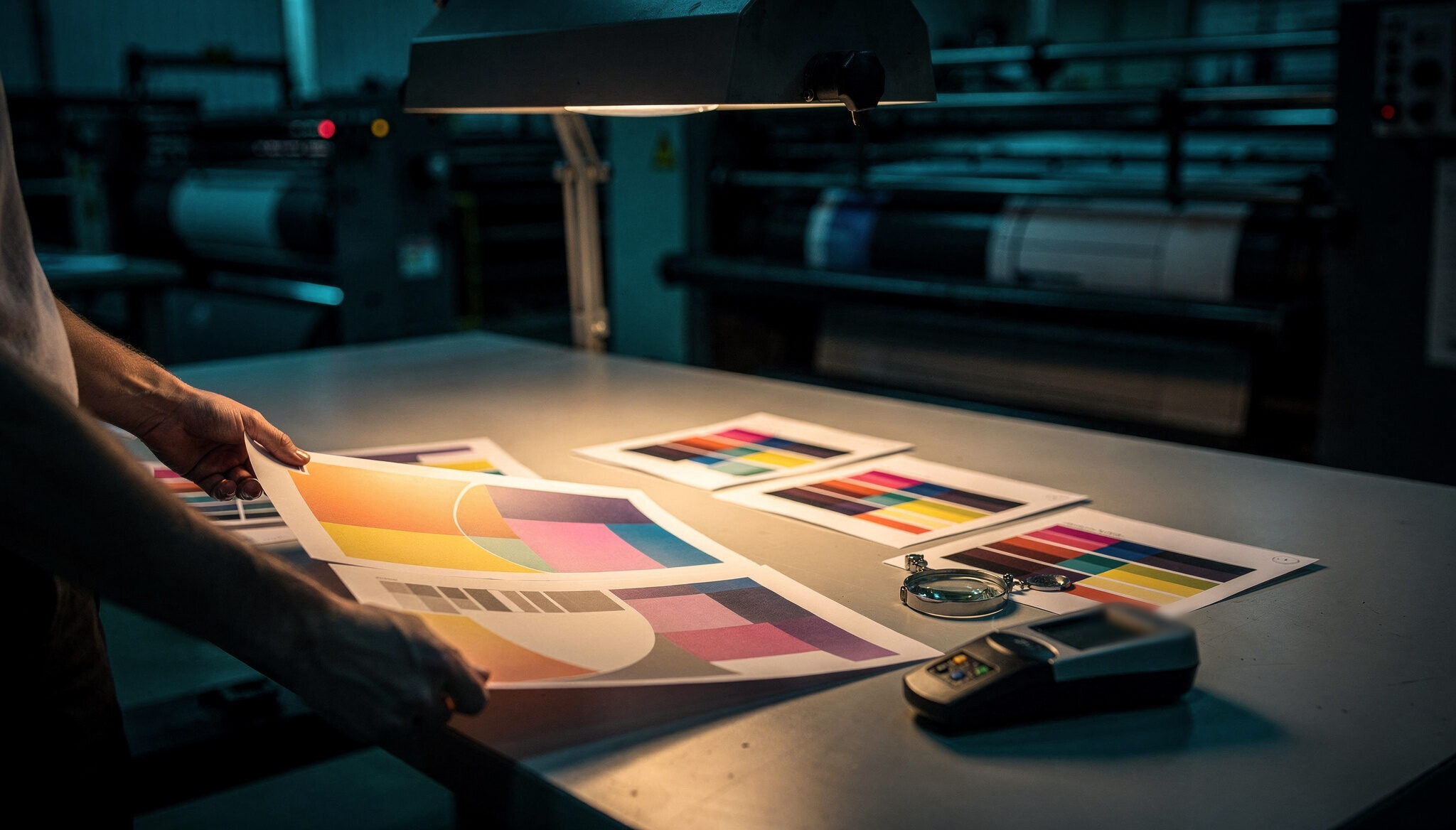
A scan or photo of a proof is compared with the approved reference, and zones that differ are flagged for the print or quality lead. This is a proposed pilot, not a validated Meridian capability. It does not replace colour measurement or your press checks, and a person reviews every flag.
Start with one product line
A sensible first project takes one product line, for example folding cartons for one market, with its recent quote requests and supplier documents. Measure how long it takes today to turn a request into a complete, checked specification, and how often a declaration is missing or has to be requested again. Compare with staged documents over a few weeks before deciding on the next step.
What Meridian would set up
- Connect
- The mailbox or folder where quote requests and specifications arrive
- Supplier declarations and certificates for board, inks and adhesives
- Your costing rules and material lists, as used in your MIS
- Build
- Key fields from requests and declarations, each linked to its source
- A list per order of what is present, missing or in conflict
- As a pilot: draft quotes for an estimator to check, and proof comparisons for a person to review
- Run
- In your own environment, next to your MIS and prepress systems
- People check every quote, declaration and flag before it is used
Illustrative set-up — every deployment is designed with the operator. Source systems stay where they are; Meridian’s data layer runs inside the operator’s own environment.
The rules add documents to every order. Reading them should not add days.
- European Commission — Packaging waste: the Packaging and Packaging Waste Regulation (EU) 2025/40
- European Commission — PPWR frequently asked questions (3 August 2026)
- European Commission — Regulation on deforestation-free products: application dates and timeline
- Intergraf — Statement on the impact of the EUDR deal on printed products (5 December 2025)
Meridian is not involved in the incidents or investigations described. Facts from public sources, as of 5 November 2026.